
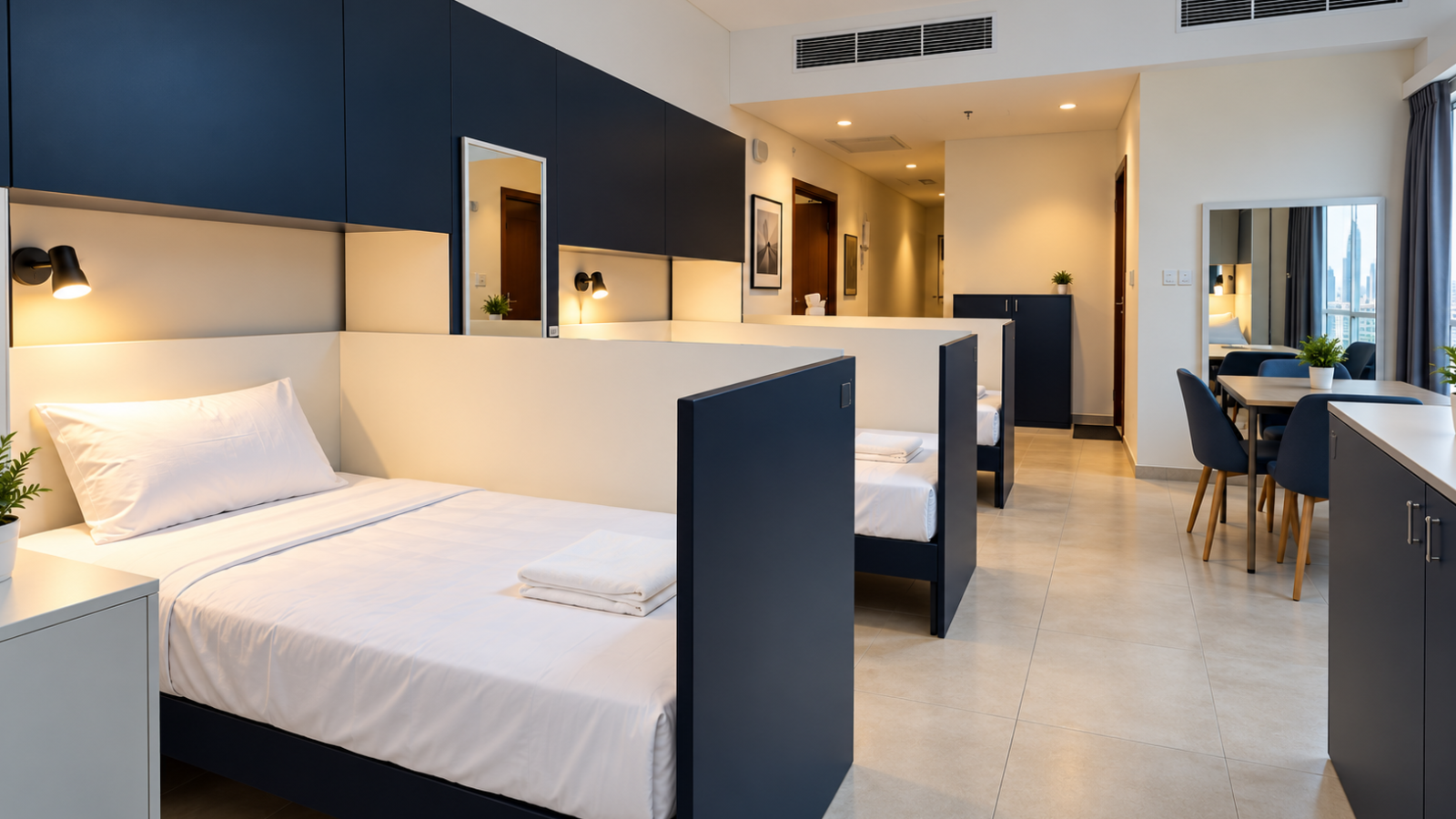
At 8:15 a.m., an employee reports that the air conditioning has stopped working. At 8:40, a supervisor asks to move two people between rooms. Before 10:00, HR is chasing a cleaning complaint, calling a landlord about a leaking tap and trying to confirm whether a technician has entered the building.
By 10:00, HR has spent much of the morning coordinating work with no clear operational owner.
Companies comparing staff accommodation for companies in Dubai often start with location, capacity and rent. Those details matter, but the operating model determines what happens after move-in. It decides who receives a fault report, who approves a room change, who follows up with contractors and who keeps employees informed.
Staff Accommodation should provide a safe, orderly place to live without turning HR into a housing help desk. That requires one reporting channel, clear task ownership, response targets, an escalation route and records that HR can review.
How housing work becomes HR work
Housing tasks rarely arrive as a formal addition to HR’s role. An employee reports a fault to the person who handled onboarding. A supervisor asks HR to arrange an urgent move. A landlord does not reply, so HR follows up. Each workaround appears temporary, then becomes the normal process.
Four gaps usually allow this to happen:
- Employees see HR as the easiest route into the company
- The housing agreement does not assign each operational task
- Properties use different landlords, contractors and reporting channels
- No single record shows rooms, occupants, open faults and completed actions
The CIPD’s guidance on strategic human resource management links people management and development to long-term business goals. Repeatedly dispatching cleaners, plumbers and technicians uses HR capacity without improving the company’s people strategy.
FAMA’s guide to reducing staff housing stress through managed workforce housing explains how clear responsibility, issue resolution and organised reporting can reduce pressure on internal teams
The hidden workload behind one request

A leaking tap may take two minutes to report. Closing the case can require several calls, access coordination, a supplier update, an employee follow-up and proof that the repair is complete.
Across several buildings, HR may be asked to:
- Receive maintenance and cleaning complaints through calls, messages and email
- Decide whether a problem is urgent without technical guidance
- Identify the correct landlord or building contact
- Arrange access around shifts and employee availability
- Chase contractors and relay estimated arrival times
- Approve moves, update room lists and recover keys
- Calm employees when nobody can confirm ownership or timing
- Reconstruct a history when the same fault returns
The bigger problem is loss of control. When requests sit in personal inboxes or messaging threads, the company cannot produce a reliable list of open cases, measure response times or identify rooms with repeated faults. HR remains accountable to employees but lacks the records needed to manage the service.
Why separate landlords increase the workload
One property may have an on-site contact. Another may require owner approval before a contractor attends. A third may divide responsibility between building management, the landlord and a maintenance company.
Companies comparing corporate housing for employees Dubai options should examine these differences before signing. Reporting channels, approval limits, access rules, contractor standards and inspection methods may change by address.
Without a common operating process, HR becomes the directory for a fragmented supplier network. A managed provider should absorb that complexity. Employees and authorised company contacts use one reporting route, while the provider identifies the responsible party, coordinates the work and records the outcome.
Employer oversight still matters
Moving day-to-day housing operations to a provider does not transfer the company’s responsibility for employee welfare, internal policy or appropriate oversight.
UAE Federal Decree-Law No. 33 of 2021 provides a wider legal framework for private-sector employment. The UAE Government also publishes official guidance on labour accommodation, including standards for living conditions. The rules that apply can depend on the workforce, property and accommodation arrangement, so companies should confirm current requirements with the relevant authority or a qualified adviser.
The ILO Workers’ Housing Recommendation 1961 No 115 also addresses adequate housing and the upkeep of worker accommodation.
For corporate staff accommodation Dubai arrangements, the company should retain welfare, policy and performance oversight. The provider should manage housing operations and supply the records needed for review. FAMA’s guide to getting staff accommodation rules right in Dubai explains why approved use, occupancy records, maintenance routes and regular reporting should be checked before and after move-in.
What a managed provider should own
The phrase fully managed staff accommodation Dubai should describe a documented operating process. A furnished room and a contact number do not meet that standard.
A capable provider should receive requests through one channel, classify each issue, assign the responsible party, coordinate access, track the case to closure and keep a usable record. It should also manage scheduled inspections, occupancy information, room-readiness checks and agreed communication with landlords or building managers.
The International Facility Management Association’s definition of facility management connects people, place and process with the functionality, safety and efficiency of the built environment. In staff housing, that principle becomes practical when every request has an owner, status and closure record.
The FAMA Staff Accommodation service centres on controlled occupancy, documentation, inspections, reporting and maintenance scheduling
| Event | Provider action | What HR receives |
|---|---|---|
| Water leak or air-conditioning failure | Log the case, assign priority, dispatch support and coordinate access | Reference number, priority and live status |
| Cleaning complaint | Inspect the issue, instruct the service team and verify the result | Closure update and agreed evidence |
| Room-change request | Check availability, obtain the required approval and manage the move | Updated allocation record |
| Repeated fault | Review case history and escalate for a lasting repair | Recurrence summary and proposed action |
| Landlord approval required | Prepare details, obtain quotations and follow up | A decision request only when company input is needed |
| After-hours incident | Use the emergency route and notify the agreed contacts | An update under the escalation procedure |
| Employee departure | Inspect the room, recover keys or access cards and prepare the space | Condition and readiness status |
Maintenance needs a defined clock
“We will handle it” is not a service level. HR needs to know when the clock starts, what the provider must do and who becomes involved if a target is missed.
The agreement with a staff accommodation provider in Dubai should define:
- The channel that creates an official service request
- Priority categories and examples for each one
- Acknowledgement, attendance and resolution targets
- The difference between temporary make-safe work and final repair
- Access responsibilities for occupied rooms
- Update frequency while a case remains open
- The escalation contact at each stage
- The evidence required before closure
Resolution time will vary. A failed component may require a replacement part, specialist contractor or landlord approval. The provider should still commit to a predictable acknowledgement, attendance, update and escalation process.
Reactive case handling is only half of the maintenance plan. IFMA’s preventive maintenance guidance explains how a proactive approach can reduce breakdown risk, limit downtime and extend equipment life. A provider should therefore show a schedule for recurring checks alongside its fault-response process.
Room changes need the same control
A room move affects access permissions, occupancy limits, cleaning requirements, inventory records and the emergency register. Treating it as an informal favour can leave several records out of date.
For employee accommodation services Dubai companies can audit, each move should follow a controlled workflow:
- Record the reason and requested timing
- Check eligibility, availability and required company approval
- Confirm that the destination room is ready
- Inspect the vacated room and record its condition
- Update keys, access rights and the live occupancy register
- Notify the employee, authorised supervisor and HR contact

This workflow leaves HR to approve only the exceptions defined in company policy. The provider handles the move, updates the records and confirms completion.
HR should retain decisions that affect employment, fairness and welfare. The provider should control the daily housing workflow within the agreed policy.
HR should remain responsible for:
- Eligibility rules and accommodation entitlements
- Sensitive welfare cases and reasonable adjustments
- Approval thresholds for exceptional moves
- Employee communication standards
- Provider performance reviews
- Escalation to leadership when a material risk remains unresolved
The provider should own request intake, work orders, landlord coordination, room readiness, inspections, occupancy records and closure evidence. Companies evaluating staff accommodation management services UAE proposals should record this division in a responsibility matrix rather than rely on verbal assurances.
FAMA’s corporate accommodation model brings allocation, occupancy planning and housing operations under one management framework.
HR also needs a short monthly report. It should show:
- Open cases by priority and age
- Acknowledgement, attendance and resolution performance
- Repeat faults by room and building
- Upcoming inspections and overdue corrective work
- Completed room moves and occupancy changes
- Cases waiting for company, landlord or contractor action
These measures let HR review service quality without reopening individual messages. They also give procurement and operations a clearer basis for provider reviews.
Eight questions before choosing a provider
Search results for managed staff accommodation Dubai can make different services appear similar. Ask each provider to demonstrate the operating process, sample records and escalation route.
- Where do employees or authorised contacts report an issue
- Who triages the request and assigns its priority
- Which response targets appear in the agreement
- Who coordinates landlords, contractors and room access
- How are room moves approved, inspected and recorded
- What happens outside normal working hours
- Which performance data will HR receive and how often
- What happens when a target is missed or a fault returns
A staff housing management company Dubai employers can rely on should be able to show a sample workflow, responsibility matrix, closed maintenance record and monthly report.
Companies comparing managed workforce accommodation UAE proposals should also ask how the service will scale when headcount, locations or shift patterns change. The answer should cover allocation control, reporting capacity and the process for adding or releasing rooms.
Move HR out of the repair queue
HR should receive service data, approve defined exceptions and protect employee welfare. It should not spend the day passing messages between employees, landlords and contractors.
FAMA Group provides Staff Accommodation and corporate housing solutions for companies that need clearer allocation, maintenance coordination and reporting. Share your headcount, preferred Dubai location and move-in date with FAMA to assess suitable options and the operating controls your company needs.
Move housing coordination into one accountable system so HR handles fewer handoffs, employees get clear updates and management can review complete records.
This article provides general operational information and is not legal advice. Organisations should confirm the current requirements that apply to their workforce and accommodation arrangements.