

What does “staff accommodation” actually mean?
Let’s be honest: housing employees sounds like a simple line item on a budget sheet… until you’re actually doing it.
Suddenly you’re managing room capacity, move-in schedules, maintenance tickets, and inspection paperwork, often all at the same time. What started as “we need a few rented units” can quietly turn into a full-blown operation of its own.
Here’s the good news: staff accommodations don’t have to be chaotic. Done well, they give your employees a decent place to live and give your HR and operations teams a clear, real-time view of occupancy, costs, and open issues. In Dubai, that housing setup may also need to check some legal boxes, depending on your headcount, your employees’ wages, and the type of property you’re using.
So let’s walk through it together: what staff housing actually means, when it becomes a legal requirement in the UAE, and what you should check before you sign anything. For companies, staff accommodation works best when treated as an ongoing operational responsibility.
One quick mindset shift before we dive in: think of staff accommodation as part of your workforce operations, not as a one-off property purchase you check off a list and forget about.
At its simplest, staff accommodation is housing that an employer arranges for its employees. You might own the property outright, lease it directly, or bring in a housing operator to supply and manage the capacity you need. The right staff accommodation model depends on workforce size, work location and shift patterns.
What that looks like in practice really depends on your workforce:
- Office employees are often housed in shared apartments.
- Hospitality teams typically live close to the hotel or resort where they work.
- Construction, logistics, and facilities-management teams are usually placed in purpose-built group housing near work sites or transport routes.
No matter which format fits your business, one thing stays constant: every staff accommodation needs a defined capacity and a named team responsible for resident records and property condition. Someone has to own it.
Wait, isn’t “staff housing” the same as “labour accommodation”?
Good question, and this trips up a lot of companies. Terms like staff housing, employee housing, workforce housing, and labour accommodation get used interchangeably in everyday business conversation. In practice, they do overlap.

But legally? Not quite. A labour accommodation can be a regulated category with its own approval, registration, building, and operating requirements. That means a regular residential apartment you’ve rented for a few employees isn’t automatically an “approved” labour accommodation just because people are living there. That is why companies should verify the legal status of any staff accommodation before signing.
Before you commit to a property, it’s worth asking: is the proposed use actually permitted here, does your planned occupancy stay within the approved capacity, and does the property meet the rules that apply to its location and accommodation type?
So, what are the UAE rules for labour accommodation?
This one comes down to three variables: how many workers you have, what they earn, and which emirate you’re operating in. Your compliance checks should start before you sign a lease or a service agreement, not after.
The federal rule: Under MoHRE Ministerial Resolution No. 122 of 2026, an establishment must provide approved and registered labour housing once it has at least 50 workers whose monthly contractual wage is AED 1,500 or less. (There’s a limited exception for certain commission-based workers at occupational level five or above, if that applies to your setup.)
The Dubai-specific rule: Dubai sets its own, higher bar. Executive Council Resolution No. 12 of 2025 requires commercially licensed establishments in the emirate with 50 or more workers earning AED 2,000 or less to provide accommodation for those workers.
These thresholds tell you when housing is mandatory under these specific rules; they don’t mean everything outside those thresholds is a free-for-all. Property use, occupancy limits, public health, tenancy law, fire safety, and municipal requirements can still apply regardless, and free zones or other competent authorities might layer on their own requirements too. Even if your numbers fall outside these thresholds, it’s still smart to document your capacity, safety measures, and resident-management controls. Good practice doesn’t need a legal trigger. A staff accommodation plan should therefore account for both federal and local requirements.
Getting approval, registration, and records right
Where the federal labour accommodation rules kick in, your housing has to be approved and registered in MoHRE’s systems. That means entering accurate information about the accommodation and its resident workers, and updating that information every time something changes. This isn’t a one-time task; accommodation owners have ongoing registration and data-update duties too. Accurate staff accommodation records also make inspections and room changes easier to manage.
In other words: record keeping is housing management, not a side task.
A few records worth keeping current at all times:
- A resident list
- An allocation register
- A move-in record
- A room-capacity report
Keeping these reconciled with what the authorities have on file makes inspections smoother and workforce changes far less stressful. For larger accommodations, take it a step further: your records should show the building, room, and assigned bed for each and every resident.
What about space, bedrooms, and basic living conditions?
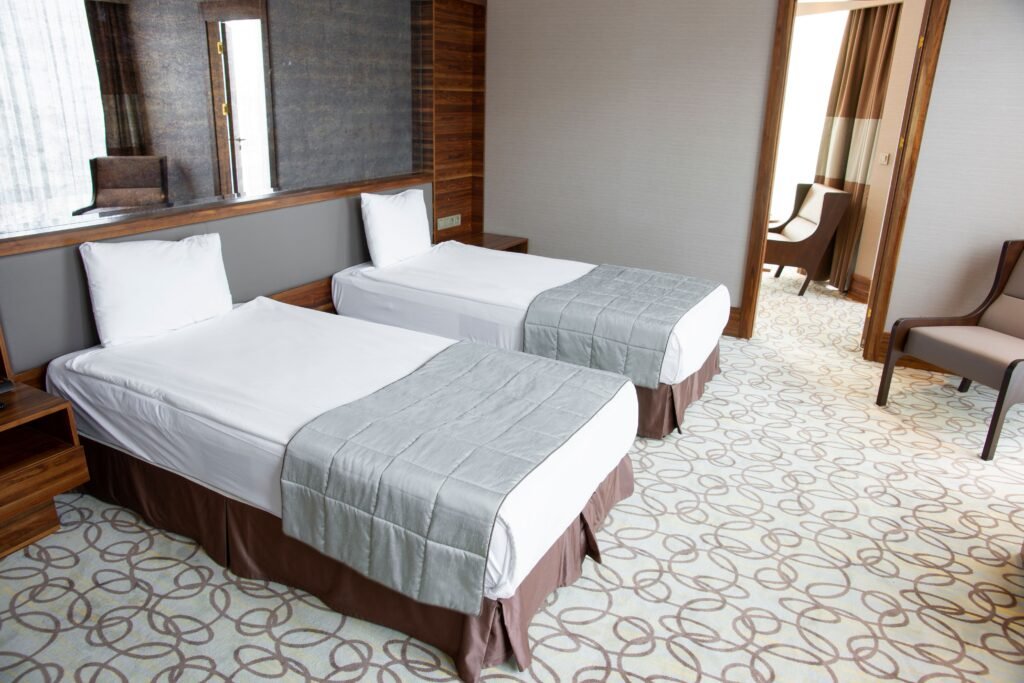
Here’s where things get concrete. The UAE Government’s labour accommodation guidance calls for housing that’s well lit, air-conditioned, and ventilated, with at least three square metres allocated to each worker. The standards referenced by the current resolution also cover bedrooms, sanitary facilities, kitchens, dining areas, laundry services, and medical facilities.
A few specifics worth knowing:
- Every resident needs a designated sleeping space and a bed, including staff who work different shifts.
- Suitable storage, clean bedding, and controls against cooking or washing inside bedrooms are also required.
- Occupancy can’t be increased just because more beds physically fit in a room.
- Bathrooms need to be sufficient for the number of residents and kept clean.
- Cooking and dining areas need proper ventilation, drainage, and pest control.
- Cold drinking water has to be available at all times.
- First-aid and isolation facilities are part of the standard, and accommodations housing 1,000+ workers carry additional medical requirements.
Day-to-day checks are what actually keep a staff accommodation within these living and occupancy standards. It’s not a “set it and forget it” situation.
What’s new in the 2026 operating requirements?
Ministerial Resolution No. 122 of 2026 didn’t just touch thresholds. It also sets out, in explicit terms, how labour housing must be operated day to day. In practice, staff accommodation now requires active oversight beyond the initial property agreement. Under the resolution, operators are required to provide:
- Maintenance: Periodic maintenance carried out by a specialist company.
- Connectivity: Free basic internet coverage.
- Security of belongings: Secure personal lockers for residents.
- Communication: Information on worker rights and safety, provided in the languages residents actually speak.
- Complaints: Visible complaint channels, plus an electronic contact point linking residents to the Labour Consultations and Claims Centre.
- Security: Licensed security around the clock, with CCTV covering entrances, exits, and common areas.
- Staffing: At least one accommodation supervisor for every 200 workers.
- Cleaning: Specialist contractors handling periodic cleaning.
- Drinking water: One cooler for every 30 workers, each with at least a 35-gallon capacity, distributed across the site.
- Food access: Where there are no nearby shops for basic food items, the establishment must provide meals that support healthy nutrition.
Together, these requirements define the day-to-day responsibilities of labour accommodation operators.
Planning staff accommodation in Dubai: where do you actually start?

Knowing you need “enough beds” is the easy part. The harder question is: where do your employees work, how do they get there, do teams rotate between sites, and how fast is your workforce likely to grow? A clear staff accommodation plan should connect bed demand with work sites and transport.
Let’s break planning down into manageable steps instead of squeezing it into someone’s already-busy week. If you would rather see how a managed provider handles staff accommodation from end to end, that is worth exploring too.
1. Start with a verified workforce schedule
Build a list of employees who need housing, along with their work locations, start dates, and shift patterns. Separate confirmed demand from possible future demand; this alone prevents two common mistakes: paying for space no one’s using, or discovering too late that new hires have nowhere to stay.
If you’re managing more than one building, decide upfront which team lives where. Transport time, shift start times, and bus capacity can matter just as much as monthly rent.
2. Confirm the property can legally be used for this purpose
Ask for evidence of the property’s approved use, accommodation licence (where required), authorised capacity, and safety approvals, and check who’s contractually responsible for
maintenance, cleaning, pest control, and utilities. Make sure the capacity in the commercial proposal actually matches what the approvals support, not just what fits on paper.
Don’t skip the physical walkthrough either. A spreadsheet can say there are “enough beds” while quietly hiding a blocked exit, poor ventilation, or a kitchen that can’t realistically serve that many people. This check helps confirm that the staff accommodation works safely in practice.
3. Set occupancy controls before move-in day
Every bed should have one assigned resident, full stop. When someone leaves, transfers, or switches rooms, that allocation record needs updating immediately, not “when someone gets around to it.” Informal swaps might feel harmless in the moment, but they quietly weaken your emergency records and make overcrowding much harder to catch.
A solid process usually covers identity checks, room assignments, access credentials, house rules, and how keys or access cards get returned. Residents should also know exactly how to report repairs and who to contact outside office hours. Clear staff accommodation procedures also reduce confusion when employees move between rooms.
4. Decide how maintenance issues get handled
Housing problems, unlike office hours, don’t clock out at 6pm. Air-conditioning faults, plumbing leaks, and access issues all need a defined reporting route, a response target, and an escalation path. This is one area where dedicated property management support tends to pay for itself quickly. You should always be able to answer: which requests are open, how long have they been pending, and is the same fault coming back again and again?
Planned inspections help you catch problems before they turn into a breakdown, and they give your operations team something more useful than “we checked, it’s fine”: photos, dates, and closure notes tied to actual issues. Regular staff accommodation inspections give managers a record of repeated faults and repairs.
5. Review performance every month
A few numbers worth tracking monthly:
- Occupied beds vs. approved capacity
- Vacant beds
- Maintenance response time
- Recurring complaints
- Upcoming arrivals or departures
The goal is simple: spot mismatches early. If one building is full and another has room to spare, a planned transfer is a lot less stressful than a last-minute scramble.
And don’t forget the finance angle. Monthly reporting helps your finance team understand the real cost per occupied bed, and rent is only one piece of that puzzle. Utilities, transport, cleaning, repairs, and unused capacity can shift the total more than you’d expect.
What should you look for in corporate staff accommodation in Dubai?

Any housing provider worth working with should be able to clearly explain how the property is operated after the agreement is signed, not just how nice it looks in the proposal. A reliable staff accommodation provider should make these daily controls visible to the client.
A few questions worth asking upfront:
- Who controls room allocations?
- Who keeps resident data current?
- Who has authority to approve room changes?
- If several vendors are involved, who’s the single point of ownership for the final record?
When you’re comparing providers, ask to see a sample occupancy report and an example of a closed maintenance request. That tells you far more than a glossy brochure ever will.
Also dig into the inspection process. How often are rooms and shared facilities checked? What evidence gets recorded? How is corrective work actually followed through? A promise that “maintenance is included” doesn’t mean much without a defined reporting and escalation process behind it.
And think ahead on capacity. A provider with staff accommodations across several residential blocks can give a growing company more flexibility to add or reduce beds without relocating the entire workforce. Just make sure any flexibility is written into the contract, including notice periods, rates, and the availability of alternative units.
Finally, ask for reporting your HR and operations teams can actually use day to day. Current occupancy, available capacity, open issues, and scheduled maintenance should all be visible at a glance, not something you have to reconstruct from a pile of emails and WhatsApp messages.
How managed housing takes work off HR and operations’ plates
Without a central operator, accommodation tasks tend to land on whoever’s closest: HR officers, site supervisors, or administrators who already have a full plate. They end up spending hours chasing vacancies, following up on repairs, and untangling conflicting resident lists.
Managing it yourself
properties
approvals
vendors
beds
move-ins
maintenance
records
reports
Managed housing
Managed staff accommodations bring all of that into one operating process. Allocation, access, inspections, cleaning, and maintenance run off the same record, so your company keeps full oversight while the routine follow-up gets handled by the housing team, not squeezed into someone’s already-busy week. With managed staff accommodation, one team can coordinate resident data, maintenance and reporting.
This is exactly the approach behind FAMA Group’s corporate housing service. The model uses central allocation management and controlled occupancy planning to help companies place new employees without overloading units, alongside live occupancy tracking, access control, inspection routines, maintenance scheduling, and central reporting.
Frequently Asked Questions
Is staff accommodation mandatory for every UAE company?
No. The federal threshold kicks in at 50 or more workers earning AED 1,500 or less per month; Dubai’s own rule lowers that wage cap to AED 2,000. Other authorities may add further requirements depending on your sector or location.
What’s the difference between “staff accommodation” and “labour accommodation”?
In everyday conversation, people use these terms interchangeably. Legally, though, “labour accommodation” can be a regulated category with its own approval, registration, and operating requirements. A regular apartment you’ve rented for employees isn’t automatically an approved labour accommodation just because staff live there; it depends on the property’s approved use and whether it meets the applicable standards.
What’s the minimum space required per worker?
Federal guidance sets this at a minimum of three square metres per worker. The approved capacity for a specific property, and any stricter local or property-specific conditions, still need to be followed on top of this baseline.
Can employees cook in their bedrooms?
No. MoHRE guidance prohibits cooking and washing inside bedrooms. Cooking should happen in a proper kitchen space with the required ventilation, sanitation, and safety controls in place.
Who’s responsible for keeping staff accommodation records up to date?
Both employers and accommodation owners carry duties under the 2026 resolution. Even when an operator manages the property day to day, the employer should still appoint a responsible internal contact. Resident, room, and move-in/move-out records need to agree across all parties involved, and match what’s registered on MoHRE’s Labour Accommodation System.
Can a company just use ordinary apartments as staff accommodation?
That depends on the specific situation and apartment. Whether it’s permitted comes down to the property’s approved use, its occupancy limits, and the rules set by the relevant authorities and tenancy documents. A standard residential lease alone isn’t proof that a unit is approved for any number or type of employee residents, so this is worth checking carefully before signing anything or moving staff in.
The bottom line
A compliant property is only the starting point. Employers still carry the compliance responsibility, making daily oversight of occupancy, maintenance and resident issues essential. FAMA Group manages this process through one system. To discuss bed counts, locations or move-in dates, contact FAMA Group’s corporate housing team.
One Response